
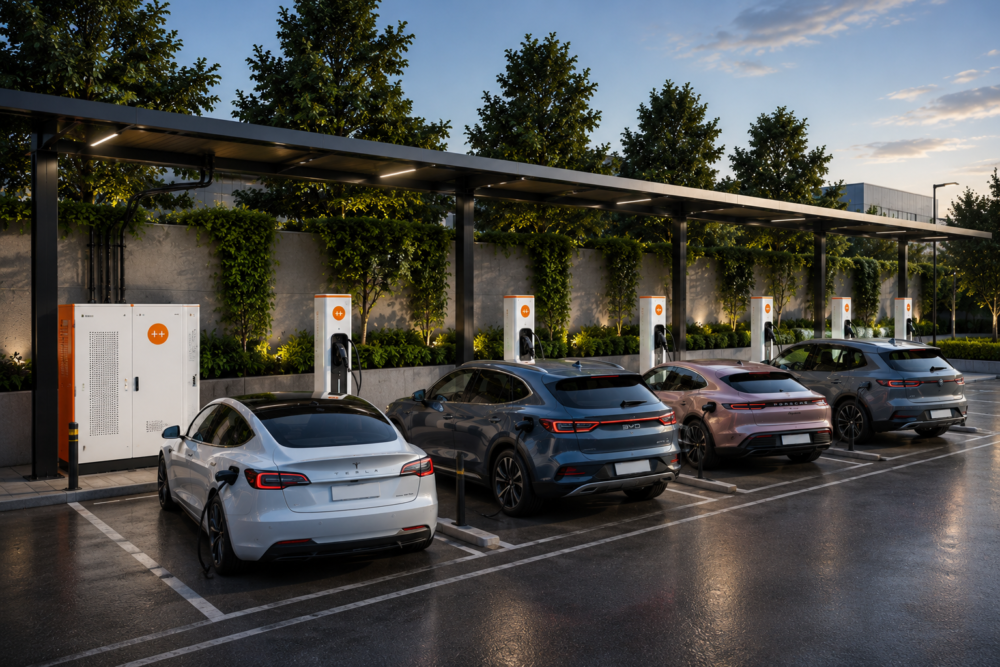
As electric vehicle adoption accelerates across Oman and the GCC, charging infrastructure operators face a critical challenge: how to maximize charger utilization while controlling investment costs, energy demand, and maintenance requirements. Distributed EV charging systems are emerging as one of the most effective solutions for public charging networks, fleet charging depots, fuel stations, shopping malls, airports, and highway charging hubs.
To understand the advantage of distributed charging, it is important to understand how an EV charges.
Contrary to popular belief, an EV does not continuously charge at maximum power. Every electric vehicle follows a charging curve. A vehicle may initially accept high charging power—such as 150 kW, 200 kW, or even 300 kW—but as the battery state of charge increases, the charging power gradually reduces to protect battery life and manage temperature.
For example, a vehicle that starts charging at 150 kW may only require 80 kW at 50% battery level and less than 50 kW as it approaches 80% state of charge. This means a large portion of installed charger capacity often remains unused.
Consider a traditional charging site with three standalone 150 kW DC fast chargers, each having two charging outputs. The site offers six charging connectors with a total installed capacity of 450 kW.
In reality, each charger can only share its own 150 kW capacity between its two outputs. If one vehicle requires only 40 kW while another requires 60 kW, the remaining 50 kW within that charger remains stranded and cannot be utilized by vehicles connected to other chargers. As a result, significant charging capacity may sit idle even when multiple EVs are waiting to charge.
Now compare this with a distributed charging system such as the technology pioneered by Kempower.
A single 400 kW central power unit connected to six satellite dispensers can dynamically allocate power to any vehicle based on its real-time charging requirement. If one vehicle needs 180 kW, another needs 120 kW, and four others require lower charging rates, the system automatically distributes power where it creates the greatest value.
This intelligent power sharing delivers several advantages:
• Higher charger utilization and more vehicles charged per day.
• Reduced grid connection requirements compared to installing multiple oversized standalone chargers.
• Lower capital expenditure through optimized use of power electronics.
• Better customer experience with reduced waiting times.
• Easier expansion by adding additional satellite dispensers as EV adoption grows.
For Oman and the GCC, there is another significant advantage. Ambient temperatures frequently exceed 45°C, especially during summer. In conventional chargers, expensive power electronics are installed within each charging unit and exposed to harsh environmental conditions.
In a distributed charging system, the power conversion equipment can be installed in a protected technical area, shaded enclosure, or climate-controlled electrical room. Only compact satellite dispensers are located in parking bays. This reduces thermal stress on critical components, improves reliability, lowers maintenance costs, and extends equipment life—an important consideration for charging operators investing in long-term EV charging infrastructure.
As public EV charging networks continue to expand across GCC region Oman, and the wider GCC, success will depend not only on charger power ratings but also on how efficiently that power is utilized. Distributed charging systems represent a smarter approach to DC fast charging by aligning available power with actual vehicle demand, improving operational efficiency, enhancing user experience, and maximizing return on investment.
For high-utilization charging hubs, fleet depots, fuel stations, and future-ready public charging networks, distributed charging is rapidly becoming the preferred architecture for the next generation of EV charging infrastructure.