
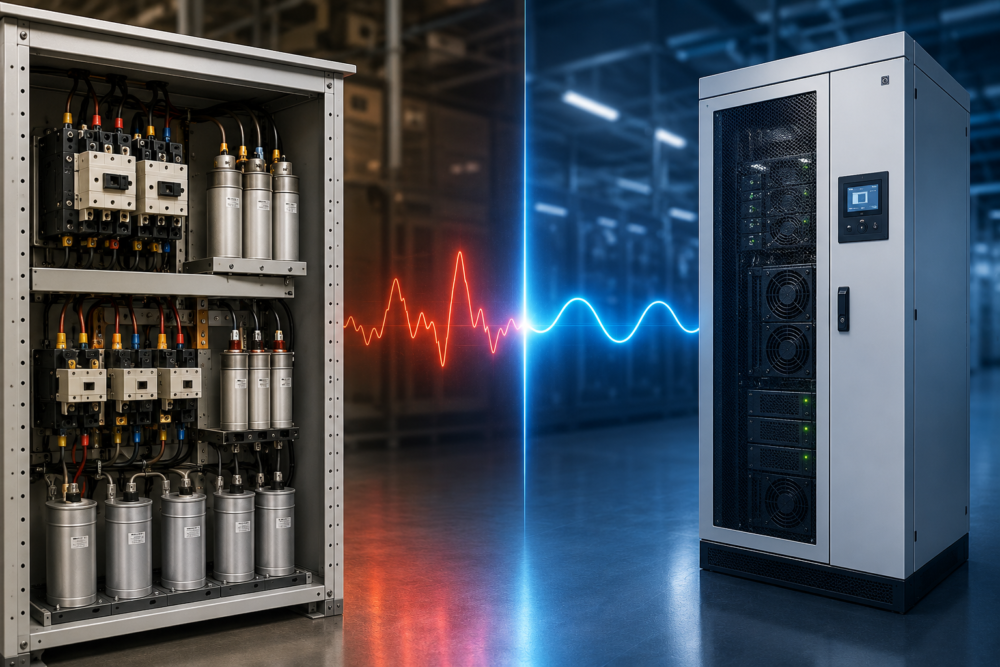
ASVG vs Capacitor Banks: Beyond Power Factor Correction
For many facilities, decisions related to capacitor banks feel routine: install a new panel with capacitor units, detuned reactors, contactors or thyristor switches, and an APFC controller. It is familiar, economical, and proven.
But modern electrical networks are no longer served by power factor correction alone. Variable-speed drives, UPS systems, EV chargers, automation equipment, lifts, chillers, compressors, welding loads, and LED systems create a more demanding power quality environment. A site may need reactive correction, compact installation, fast response, and harmonic mitigation at the same time.
This is where ASVG, or Advanced Static VAR Generator, changes the discussion.
ASVG is an IGBT-based active compensation system. Instead of switching fixed capacitor stages, it measures the load in real time and injects the required compensating current. The result is stepless VAR correction, fast response, and precise control across stable and changing loads.
Why Conventional Capacitor Banks Still Work
Conventional capacitor banks are useful when the load is stable, harmonic distortion is low, space is available, and the required kVAR can be matched well using fixed stages. They can improve power factor and reduce apparent power demand.
Their limitation is step-based correction. If the load requires 63 kVAR and the nearest available stage combination is 50 kVAR or 75 kVAR, the system must accept undercompensation or overcompensation. With changing loads, this mismatch repeats.
Capacitor-bank panels also include components that age or need inspection: capacitors, reactors, contactors, fuses, terminals, ventilation, and control wiring. In harmonic-rich sites, poor design can cause resonance, overheating, nuisance tripping, or capacitor stress.
What ASVG Adds
ASVG provides reactive power compensation without fixed capacitor steps. It can correct inductive and capacitive reactive power within its rated range, helping prevent both poor lagging power factor and unwanted leading power factor.
ASVG can also work for stable loads. The benefit is not only speed; it is precision. Even when the load is steady, ASVG can maintain the target power factor without being limited by stage size. For dynamic loads, it responds without stage switching.
The “advanced” part is important. Properly sized ASVG systems can allocate part of their capacity for dominant harmonic mitigation, commonly up to about 50% of rated capacity depending on design, settings, and site conditions. This may reduce or delay the need for a separate Active Harmonic Filter where harmonic levels are moderate and dominated by lower-order components.
That does not make ASVG a universal replacement for dedicated harmonic filters. If harmonic current is high, broad-spectrum, compliance-critical, or beyond reserved ASVG capacity, a dedicated Active Harmonic Filter may still be required. The correct answer must come from a professional Power Quality study.
Technology Comparison
Reactive Power Correction
Conventional Capacitor Bank: Fixed capacitor stages
ASVG: Stepless active current injection
Why it matters: Better matching to real load demand
Response
Conventional Capacitor Bank: Controller and stage-switching dependent
ASVG: Fast electronic response
Why it matters: Useful for changing loads and tighter power factor control
Stable-Load Operation
Conventional Capacitor Bank: Effective when stage sizes match the load
ASVG: Effective with precise target power factor control
Why it matters: ASVG is not limited to dynamic sites
Leading / Lagging Correction
Conventional Capacitor Bank: Mainly capacitive correction
ASVG: Inductive and capacitive compensation
Why it matters: Helps avoid overcorrection during light-load conditions
Harmonic Environment
Conventional Capacitor Bank: Requires detuning and resonance checks
ASVG: Can mitigate dominant harmonics within reserved capacity
Why it matters: May reduce the need for a separate Active Harmonic Filter in moderate cases
Footprint
Conventional Capacitor Bank: Larger with capacitor units and reactors
ASVG: Compact modular power electronics
Why it matters: Important in retrofit electrical rooms where space is limited
Maintenance Profile
Conventional Capacitor Bank: Capacitor aging, contactor wear, fuse and reactor checks
ASVG: Fewer stage-switching components
Why it matters: Can improve lifetime operating cost
Future Flexibility
Conventional Capacitor Bank: Limited by installed steps
ASVG: Adaptable within rated capacity
Why it matters: Better when site loads may change in the future
Lifetime Cost: The Real Comparison
A capacitor bank may still be right for a simple, stable, low-harmonic load where space is not a concern and maintenance access is easy. But in practice, the amount of power electronics used is increasing, whether in buildings or industries. Variable Frequency Drives, automation systems, and EV chargers are adding to non-linear loads and operating under tighter reliability expectations.
ASVG can improve lifetime value by reducing stage mismatch, avoiding frequent capacitor switching, supporting compact retrofits, correcting leading and lagging reactive power, and adapting as the load profile changes. In moderate-harmonic sites, one ASVG installation may address both power factor and selected harmonic concerns, provided the unit is sized with enough spare capacity for both functions.
This matters when comparing total project cost. A conventional solution may need a capacitor bank, detuned reactors, future expansion, and possibly a separate Active Harmonic Filter. A properly selected ASVG may simplify the system. In other cases, a hybrid design may be best: capacitors for base kVAR, with ASVG handling fine correction, unbalance, and dominant harmonics.
Conclusion
Capacitor banks are proven, but they are no longer the only practical answer. ASVG moves the discussion beyond fixed-stage compensation by combining stepless VAR control, fast response, compact installation, and selective harmonic mitigation.
For customers replacing old capacitor panels or planning new systems, the smarter question is not only, “What is the lowest equipment cost?”
The better question is, “Which solution gives the lowest lifetime cost while improving power factor, reducing maintenance exposure, saving space, and preparing for future load changes?”
In many modern facilities, ASVG deserves to be evaluated before the next capacitor bank is selected.